
by Aravind Boddupalli, Rekha Balu, Seema Agnani, Wayne Ho
In April, New York City Mayor Zohran Mamdani released the Preliminary Citywide Racial Equity Plan and an inaugural True Cost of Living Measure, recognizing that more-nuanced, local data are critical to effectively address the affordability crisis. A related Urban Institute report found 63 percent of Asian American (AA) and Native Hawaiian and Pacific Islander (NHPI) New Yorkers don’t earn enough to meet their true cost of living, a share significantly higher than the 44 percent of their White counterparts.
These are stark findings, but they lump together the outcomes of some of the city’s highly diverse AA and NHPI communities. Cost of living (PDF) is top of mind for AA and NHPI adults, as it is for most Americans, and has been for decades. Unfortunately, their economic experiences remain poorly understood in policy debates dominated by national averages. This lack of visibility has real consequences.
Further disaggregating the data by racial or ethnic group could help identify unique needs and root causes, which could ultimately help the city generate more effective solutions. Recent findings from the Urban Institute and National CAPACD aim to do just that and offer tangible insights for changemakers in New York and beyond.
Disaggregated data reveal stark variations in poverty
Across the US, poverty rates among AAs range from 11 percent among Indian Americans to more than 30 percent among Mongolian, Bangladeshi, and Malaysian communities. Within the NHPI population, poverty ranges from roughly 13 percent for Chamorro households to more than 30 percent among non‑Chamorro Micronesian and multiethnic (other and multiple NHPI) groups.
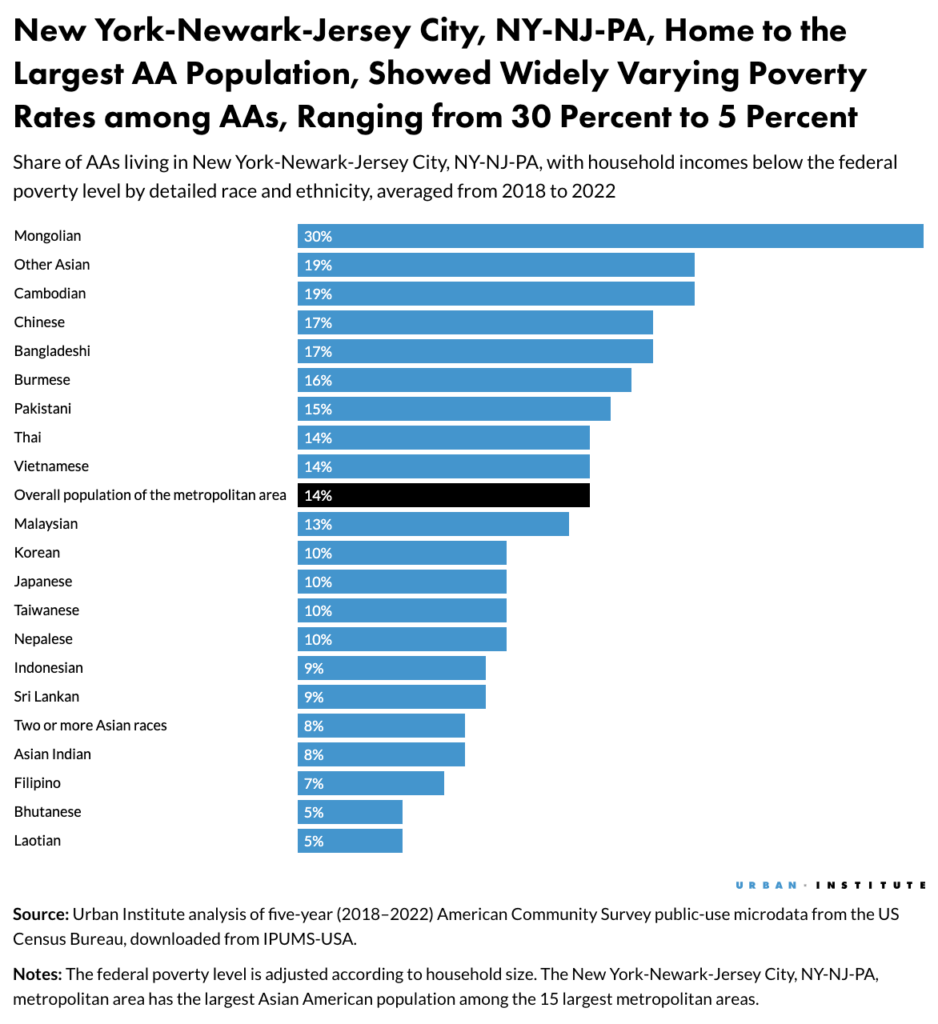
These patterns are even more pronounced when examined at the city level. In the New York–Newark–Jersey City metropolitan area, AA poverty ranges from 30 percent among Mongolian residents to 5 percent among Laotian and Bhutanese residents, a 25‑point spread within a single region.
Are current affordability solutions working for AA and NHPI communities?
Until cities collect and disseminate disaggregated evaluation data, policymakers, researchers, and advocates may struggle to assess the efficacy of solutions for serving the disparate needs of certain AA and NHPI communities.
However, there are signs of progress. After years of advocacy by the 18% And Growing Campaign, the New York City Council recently strengthened legislation establishing citywide standards for collecting disaggregated demographic data across seven of the city’s largest agencies. As implementation has begun, data reforms will be put to the test, informing program and policy design, and evaluated against the equity goals established in the racial equity plan and agency-specific plans. City agencies will be able to assess utilization and impact of programs and services for their AA and NHPI communities, as well as other historically underserved communities. For example, within the city’s Racial Equity Plan, the NYC Department of Social Services outlines their goal to update antiquated public assistance benefits policies and levels to reduce household poverty, eliminate racial disparities in economic security, and bring residents closer to the NYC True Cost of Living.
As the affordability crisis persists, with higher prices for food, child care, housing, and energy, localized and disaggregated data will be essential to ensuring that those most affected by the affordability crisis actually benefit from proposed solutions. In a city as large as NYC, a neighborhood can have as many as 100,000 people, the equivalent of a midsize city in other states. Differences from neighborhood to neighborhood are key to understanding the varying conditions and challenges.
Initiatives such as Undo Poverty Flushing aim to address this need for nuance and address poverty at a hyperlocal level. Undo Poverty, led by the Chinese-American Planning Council, is working with community residents directly to define poverty and affordability in the Flushing neighborhood. It also builds skills for those community members to be involved in advocating for housing policy, workforce development, and social services that contribute to Flushing’s unique affordability needs.
A path forward
May is AAPI Heritage Month and is as good a time as any to recognize the value in identifying variations among AA and NHPI communities across the US.
Our research shows that any place seeking to improve affordability for AA and NHPI people and communities more broadly should consider the following evidence-based practices:
- Increase disaggregated data collection across all major affordability programs, as highlighted in an Urban Institute data guide.
- Embed community-led policy design, drawing on the lived expertise of organizations rooted in AA and NHPI communities.
- Expand evidence-backed housing strategies, including permitting, zoning reforms, tenant protections, utility cost assistance.
- Ensure policies center families with low and middle incomes, who face the sharpest affordability pressures.
Philanthropic, government, advocacy, and research stakeholders each have a role in improving the well-being of our underserved populations. With stronger data, community collaboration, and targeted investments, we can develop solutions that recognize their lived realities and meet the needs of AA and NHPI communities today.