
National CAPACD’s Community Arts Framework: A Cultural Approach to Capacity Building for Asian Americans is the culmination of research exploring how community arts initiatives (including placemaking and placekeeping projects) help community organizations build their capacity to affect neighborhood change, such as gathering neighborhood history, fostering a sense of belonging, and promoting long-term community stewardship. The findings come from analysis of data gathered through a national survey of AA and PI-serving organizations and in-depth case studies examining both the challenges and opportunities of implementing community arts initiatives.
This report illustrates how arts and community development organizations use creative, culturally aligned programs that lead to positive community outcomes. This research attempts to more fully explore how arts and culture build a community’s capacity to sustain and protect their neighborhoods
The researchers developed a conceptual framework that looked at neighborhood capacity through six dimensions:
- Knowledge Capacity: Gather, learn, and pass on history, experiences, and traditions of people and places.
- Creative Capacity: Use arts and culture to self-define and express individual and shared identity and envision the future.
- Relational Capacity: Build a connected community through groups, organizations, networks, and coalitions.
- Political Capacity: Influence decision-makers and participate in planning and allocating resources for a neighborhood.
- Economic Capacity: Identify, mobilize, and expand community assets and resources.
- Affective Capacity: Foster a sense of belonging, shared identity, and shared future.
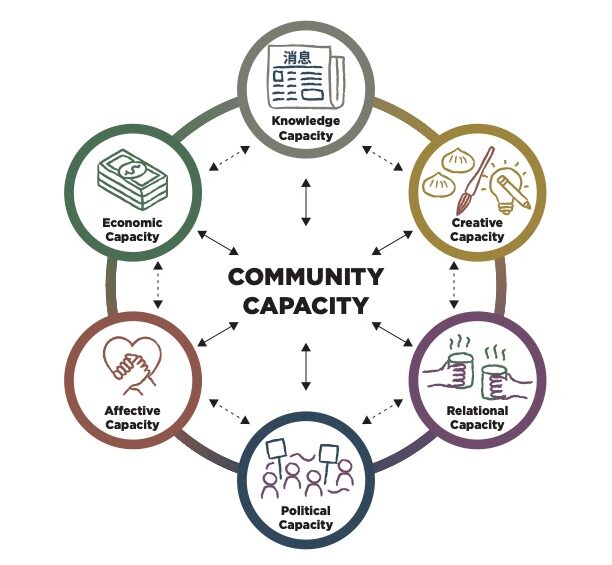
This framework is intended to serve as a resource for cultural communities to build networks, knowledge, and other capacities to support cultural, economic, and civic vitality that contribute to community resilience. It also underscores to funders and policymakers the importance of sustained investment, institutional support, and strategic design to maximize community benefits.